
Clinical Insights
Clinical Studies
-

Integration of point-of-care testing for sickle cell disease into primary care in northern Ghana: a prospective feasibility study
LANCET PRIMARY CARE • August 5, 2026
This prospective feasibility study evaluated the integration of Gazelle® sickle cell disease testing into routine immunization services at 10 primary health-care clinics in rural northern Ghana. Screening was conducted by existing facility staff, with same-day results, without creating a separate screening program. Among 6,024 children younger than five years, 81 were confirmed to have sickle cell disease. Of those, 97.5% entered specialized care, and 94.9% remained in care after 24 months. The findings demonstrate the feasibility of integrating decentralized screening, confirmatory diagnosis, and long-term care into existing primary-care services.
-

Enhancing access to sickle cell disease diagnosis in Africa using the Gazelle® portable digital microchip electrophoresis platform
BLOOD CELLS, MOLECULES, AND DISEASES • 2026
This study evaluated Gazelle in 1,360 participants in Kano, Nigeria, comparing results with HPLC. Testing was performed by locally trained healthcare workers and laboratory personnel, with participants ranging from newborns to adults.
Gazelle demonstrated 100% sensitivity and specificity for distinguishing sickle cell disease from both normal and sickle cell trait, and 99.7% sensitivity for distinguishing sickle cell trait from normal. The authors concluded that Gazelle’s portability, ease of use, and strong diagnostic performance support its potential integration into screening programs in regions with a high burden of sickle cell disease and limited access to conventional laboratory testing.Description goes here
-

Validation of Gazelle Microchip Electrophoresis for Premarital Hemoglobinopathy Screening in Türkiye
eJHaem • June 2026
This study evaluated Gazelle against HPLC for premarital hemoglobinopathy screening in Türkiye, enrolling 616 participants, including 100 known β-thalassemia or sickle cell carriers. Among 516 participants undergoing routine screening, 16 hemoglobinopathy traits were identified, including 14 β-thalassemia traits, one HbS trait, and one HbD trait.
-
Evaluation of Diagnostic Accuracy of Sickle SCAN™, and Gazelle™ for Screening Hemoglobin S in india
INDIAN JOURNAL OF HEMATOLOGY & BLOOD TRANSFUSION• April 5, 2025
This prospective study of 470 patients compared the performance of two point-of-care tests for hemoglobin S detection against high-performance liquid chromatography (HPLC). Gazelle™ demonstrated 100% sensitivity for identifying homozygous sickle cell disease and 98.4% sensitivity for sickle cell trait, with strong agreement to HPLC for quantitative hemoglobin S measurements. The authors concluded that Gazelle provides accurate, rapid, and interpretable results suitable for point-of-care screening in high-prevalence settings.
-
Evaluation of low-cost techniques to detect sickle cell disease and β-thalassemia: an open-label, international, multicentre study
THE LANCET SOUTHEAST ASIA • April 2025
This international, multicentre study evaluated the diagnostic performance of six low-cost point-of-care tests for detecting sickle cell disease (SCD) and β-thalassemia traits in blood samples from Nepal and Canada, using HPLC as the reference standard. Four tests (HemoTypeSC, Sickle SCAN, Gazelle, and an automated sickling test) accurately identified severe SCD forms, but only Gazelle and the automated sickling test reliably detected both sickle cell trait and β-thalassemia carrier states.
-

Real-World HbF Status in Sickle Cell Disease from an Endemic Zone
FORTUNE JOURNALS • February 1, 2023
This real-world observational study evaluated fetal hemoglobin (HbF) levels in 114 patients with sickle cell disease receiving hydroxyurea therapy in an endemic region of India. Point-of-care hemoglobin electrophoresis showed that most patients achieved clinically meaningful increases in HbF, frequently exceeding 20%, despite fixed-dose treatment and limited follow-up. The findings underscore the importance of accessible hemoglobin fraction measurement to support therapeutic monitoring in routine clinical practice.
-

Point-of-Care Diagnostic Test for Beta-Thalassemia
BIOSENSORS • February 5, 2024
In this clinical study conducted among 404 subjects in Ghatkopar, Mumbai, India, Gazelle demonstrated 100% sensitivity and specificity for identifying β-Thal major/intermedia vs. healthy subjects as well as subjects with β-Thal major/intermedia vs. β-Thal trait. Additionally, Gazelle demonstrated 100% sensitivity and 98.3% specificity for identifying β-Thal trait vs. healthy subjects.
-

Multispectral Imaging for MicroChip Electrophoresis Enables Point-of-Care Newborn Hemoglobin Variant Screening
HELIYON • December 6, 2022
In this clinical study conducted among 441 subjects including 250 subjects from 0 to 3 days old, 15 subjects from 4 to 28 days old, and 176 subjects from 28 days to 6 months old in Korle Bu, Ghana, Gazelle-Multispectral demonstrated 100% sensitivity and specificity for identifying newborns with diseases vs. healthy subjects; and subjects with disease vs. subjects with sickle cell trait and Hb C trait; Additionally, Gazelle-Multispectral demonstrated 97.3% sensitivity and 96.6% specificity for identifying subjects with sickle cell trait and Hb C trait vs. healthy subjects.
-

Evaluation of Microchip-Based Point-Of-Care Device “Gazelle” for Diagnosis of Sickle Cell Disease in India
FRONTIERS IN MEDICINE • December 10, 2021
In this study, Gazelle, a new point-of-care, microchip-electrophoresis based sickle diagnostic device was compared to conventional laboratory-based hemoglobin electrophoresis and HPLC. The sensitivity and specificity of the Gazelle is comparable to hemoglobin electrophoresis and HPLC and eliminates the need for a laboratory. Gazelle yielded an overall high accuracy (99.0%) compared to reference standard tests (HPLC and hemoglobin electrophoresis).
-
Point-of-care microchip electrophoresis for integrated anemia and hemoglobin variant testing
LAB ON A CHIP • October 21, 2021
This article describes the first point-of-care (POC) platform to perform both anemia detection and Hb variant identification, using a single paper-based electrophoresis test.
-

Paper-based microchip electrophoresis for point-of-care hemoglobin testing
ANALYST • April 30, 2020
HemeChip is a versatile, mass-producible microchip electrophoresis platform technology that may address unmet needs in biology and medicine, when rapid, decentralized hemoglobin or protein analysis is needed.
Clinical Presentations and Webinars
-
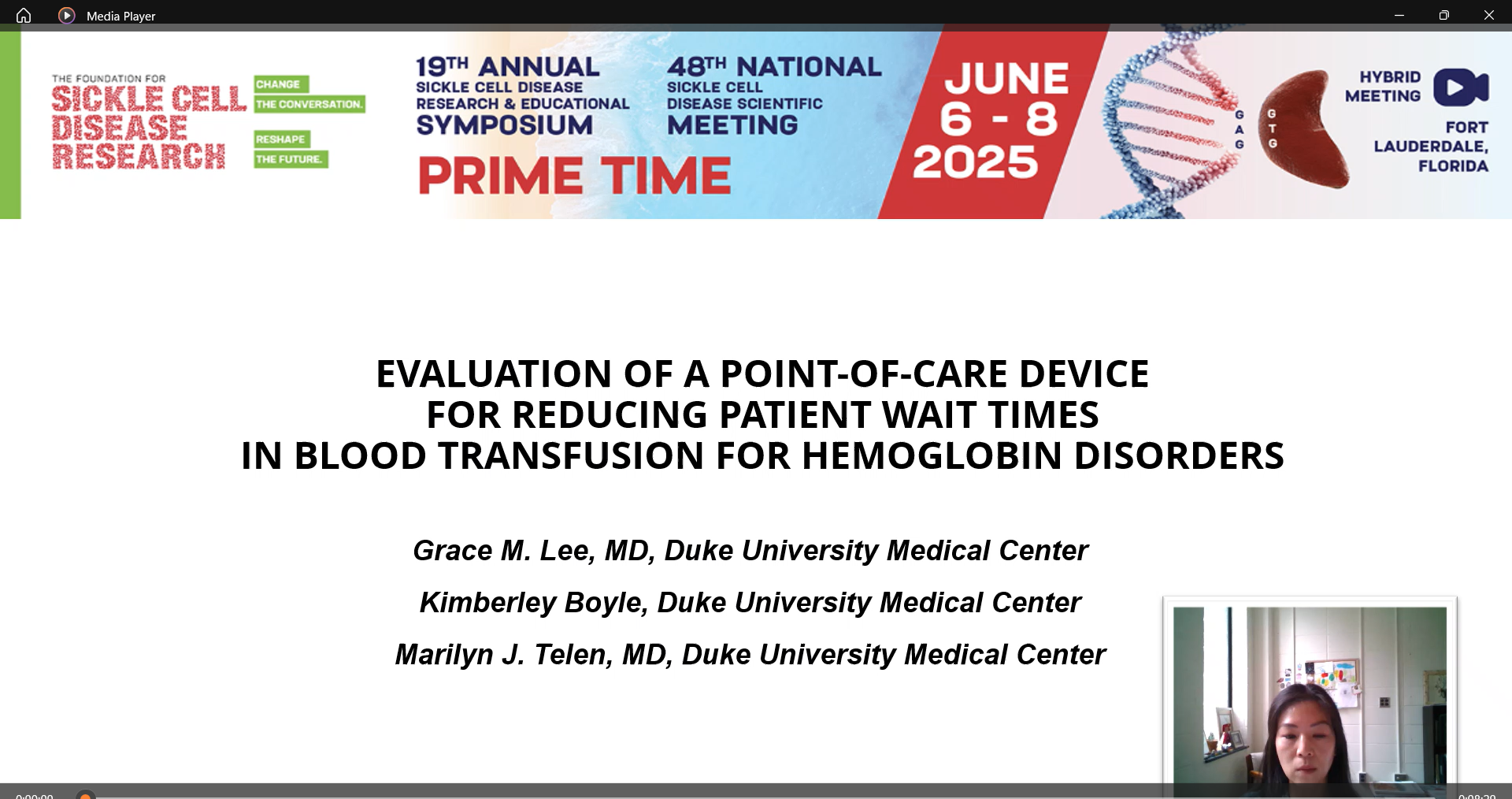
Oral Presentation to FSCDR 2025 on reducing wait times for transfusion patients
Evaluation of a point-of-care device for reducing patient wait times in blood transfusions for hemoglobin disorders, presented by Grace M. Lee, MD, Duke University Medical Center.
-

Oral Presentation to FSCDR 2024 on fetal hemoglobin quantification
Cathy Segbefia, MD, Department of Child Health, University of Ghana Medical School and Korle Bu Teaching Hospital, Accra, Ghana presented “Point-of-care diagnostic for foetal haemoglobin quantification in children undergoing hydroxyurea therapy for Sickle Cell Disease (SCD) in Ghana” at the 2024 Foundation for Sickle Cell Research conference in Ft. Lauderdale, Florida on June 9th.
-

Prevention and Early Detection of Beta Thalassemia
Akshat Jain M.D., M.P.H. , Medical Director, International Hematologist, Oncologist & Stem Cell Transplant Specialist from Loma Linda University, shed light on methods and benefits of early beta thalassemia detection on this webinar for World Thalassemia Day, 2024
Recent Posters
-
-
ASH, December 2025
First Miniaturized Electrophoresis Diagnostic Platform in USA for Hemoglobinopathies: From Diagnosis to Therapeutic Monitoring in Real Time [png]ASH, December 2025
Advancing Sickle Cell Disease Diagnosis in Low-Resource Settings Using Gazelle, a Paper-Based Microchip Electrophoresis Platform [png]ASH, December 2025
Budget Impact Analysis for Point of Care Testing for Sickle Cell Disease in Mozambique [png]ASH, December 2025
Feasibility, reliability, and accuracy of point-of-care measurements of fetal hemoglobin [png]ASH, December 2025
Causes of Death in Young Children with Sickle Cell Disease and Sickle Cell Trait in the Child Health and Mortality Prevention Surveillance (CHAMPS) Network [png] -
ASH, December 2024
Point-of-Care Diagnosis for Hemoglobinopathies: Novel Microchip Electrophoresis for Detection in Indian Populations [pdf]ASCAT, October 2024
Premarital Screening of Thalassemia and Hemoglobinopathies with Microchip Electrophoresis (Gazelle™) Method in a Turkish Population [pdf]ASCAT, October 2024
Evaluation of a New Point-of-Care Diagnostic Tool for Newborn Screening in Ghana [pdf]EHA, June 2024
Integration of Point-of-Care Testing in Primary Health Care Facilities for Early Comprehensive Management of Sickle Cell Disease in Rural Kassena Nankana Districts of Ghana [pdf]FSCDR, June 2024
Point-of-care diagnostic for quantification of foetal haemoglobin (Hb F) levels in monitoring hydroxyurea therapy for children with Sickle Cell Disease (SCD) in Ghana [pdf]
